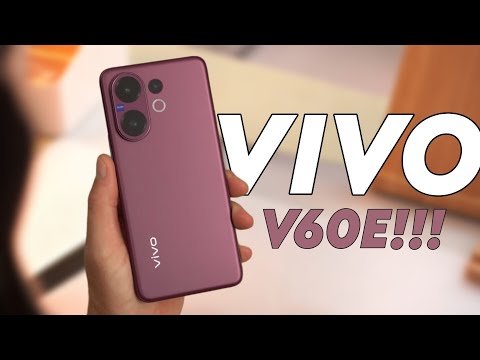
When you hear “50 MP” in a smartphone spec sheet, you often imagine crisp, ultra-high‑resolution photos with room to crop. But in many cases, the real output is limited by software, compression or sensor binning. The surprising thing about the Vivo V60e (leaked or rumored specs) is that its 50 MP sensor appears to deliver a full 8150×6150 pixels image output — far beyond the norm in its class.
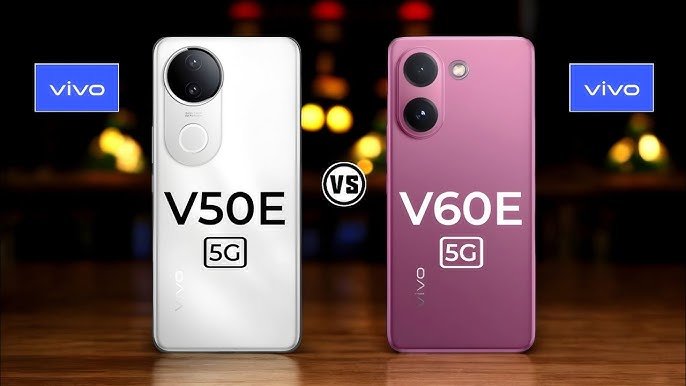
What does 8150×6150 resolution really mean?
To put it simply, an image of 8150×6150 px means about 50.1 million pixels (50.1 MP). In many midrange phones, even if the sensor is 50 MP, the camera app might output 12‑ or 24‑MP images by binning pixels or using aggressive compression. But in this case, the output suggests true native 50 MP capture with limited downscaling — which is rare in this price segment.
This means you get more flexibility when cropping, more detail when viewing on large displays, and more headroom for post-processing. It also means the sensor quality, optics, and ISP (image signal processing) pipeline must be well tuned to avoid noise or artifacts at full resolution.
Leaked and confirmed camera specs
Based on the leaks and spec listings so far:
- The Vivo V60e is said to launch with a 50 MP wide-angle main camera, likely with optical image stabilization (OIS) and a bright aperture. (91mobiles)
- The secondary / auxiliary cameras include a 13 MP unit and an 8 MP ultra-wide sensor. (91mobiles)
- On the front, recent leaks point to a 32 MP selfie camera. (News24)
- The handset is tipped to ship with a MediaTek Dimensity 7300/7360 (4 nm) chipset, which should provide enough processing horsepower for handling heavy image data. (91mobiles)
- Battery capacity rumors range around 5,600 mAh to 6,500 mAh, and fast charging (around 90W) is expected. (Mobile with Prices)
If the 8150×6150 px output proves real, it will put the V60e among a small set of midrange phones that actually deliver full resolution rather than downsample.
What to look for (and what to test)
If you decide to test the camera (or review the phone), here are a few key checks:
- RAW / DNG output — see if the camera app allows you to save uncompressed data. That gives insight into the true sensor capture.
- Cropping without loss — crop a portion of the frame and check clarity. At 8150×6150, even heavy crops should retain detail.
- Low-light performance — full resolution often comes at the expense of noise suppression. Check how well it handles shadows, night shots, and high ISO.
- Lens quality & sharpness across the frame — corners, edges, central sharpness, especially at full resolution.
- Software vs hardware compression — compare output under different modes (portrait, night, pro) to see if the phone switches to lower-res capture in certain modes.
Why this matters
Many consumers are misled by megapixel numbers. A 108 MP or 200 MP sensor sounds impressive, but often results are still downsampled or heavily processed. A phone that truly gives you ~50 MP usable output, especially in a midrange bracket, can be a game changer. It bridges the gap toward flagship-level imaging without an exorbitant price.
If Vivo achieves this reliably, the V60e could stand out in camera-centric phones at its price tier. It could also force competitors to be more honest about their “native” resolution output.
FAQs
Q1. Is 8150×6150 px exactly 50 MP?
Yes — 8150 multiplied by 6150 equals ~50,107,500 pixels, which is about 50.1 MP. That aligns with the marketed 50 MP sensor.
Q2. Will all photos be saved at that full resolution?
Not necessarily. Some modes (night, portrait, ultra-wide) might use binning, noise reduction, or lower-resolution output for performance or file-size reasons.
Q3. Does higher pixel count necessarily mean better image quality?
No — sensor size, lens quality, RAW pipeline, noise control, and software tuning all matter more than just pixel count.
Q4. How will this affect low-light / night photography?
Capturing full 50 MP in low light is more challenging. The phone may need to rely on multi-frame stacking or binning to reduce noise, which could diminish sharpness.
Q5. Can cropping a full-res image retain quality?
Yes — at 8150×6150, you have a lot of room to crop and still produce a sufficiently detailed image for many uses, even large prints.